At home on the Grange

By Donita Naylor | Journal Staff Writer
EXETER Members of the Exeter Grange, at their first meeting in November 1887, agreed to pay $22 a year to rent a hall plus lights, fuel and the services of a janitor. That hall was probably an octagonal building in Fisherville known as “the Toadstool” and shared with the Odd Fellows and a Temperance Society, according to a history written in 1987 by Robert A. Bates for the grange’s 100th anniversary.
By 1919, the grange had bought its current building on 469 Ten Rod Road (Route 102) from the Odd Fellows for $1,000, Bates wrote in his history. The two-story building, with an addition, is now assessed at $303,200.
On Monday night, the Exeter Grange will celebrate its 125th anniversary there with an open meeting, reception and entertainment by Nicolas King, beginning at 7:30 p.m.
The event was originally scheduled for Oct. 29, but had to be postponed because superstorm Sandy was blowing. Although the hall was not damaged, many roads in the rural community were impassable and the power was out.
But Bates won’t be among those marking the milestone. He died in January 2011, when his car was hit as he left the Middle of Nowhere Diner.
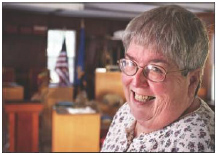
As explained by Peggy Fish, 61, who lives in West Greenwich but has been going to the Exeter Grange since she was 16, the grange is a fraternal organization “that at one point did a lot of farm stuff,” but now “we’re what you would call a social group.”
The National Grange of the Order of Patrons of Husbandry was founded in 1867 to promote the interests of farms and rural life. It claims a role in promoting women’s suffrage, interstate commerce law, parcel post and, in Rhode Island, forming the state police and the State Agricultural School, which is now the University of Rhode Island.
Saturday-night dances began around 1920, Bates wrote, and they were still going strong in the ’40s and ’50s. “No one, but no one, missed any of these dances unless they had double pneumonia and a broken leg,” he wrote.
Even when the dance crowd spilled outdoors, there was never a problem with alcohol, he wrote. “Drinking was forbidden; anyone who had been drinking was quietly asked to leave by the four big boys: Nate Andrews, Scott Ed-wards, Charles Fulford and Lawrence Andrews.”
For most of Fish’s life, she said, grange dinners packed them in. Fire and health codes put a stop to those about two years ago. The building is old, she said, and upgrades would have been too expensive.
She said, however, “We never made anybody sick. I’m very proud of that.”
Each year in early November, grange members sell crafts at their Harvest Festival, and people who shop there “talk about how much they miss the suppers,” Fish said.
Instead, to raise money for operating expenses, the grange sells French fries every August at the Washington County Fair.
“We know everything we need to know,” she said, “to cook three tons of potatoes in five days.”
Exeter Grange members march in the Exeter and West Greenwich Memorial Day parades and sponsor a “People and Paws” walkathon each spring. They raise about $1,200 that’s split between the Exeter food bank and the Exeter animal shelter.
As another community-service project, the grange buys a dictionary for every third grader in Exeter, West Greenwich and Block Island.
And 4-H groups can use the hall for wreath-making workshops in December and for “Wag N Tails,” the dog-obedience classes that 4-H has added because, Fish said, “not everybody can keep a cow in their backyard .”
The grange, which welcomes people of all ages, meets on the third Thursday of each month.
At the 125th celebration, members will hold an open meeting, with a Bible-opening ceremony and the Pledge of Allegiance. State grange awards will be handed out, and members of the Exeter Town Council will present a proclamation.


