Grange to fight huge infringement case

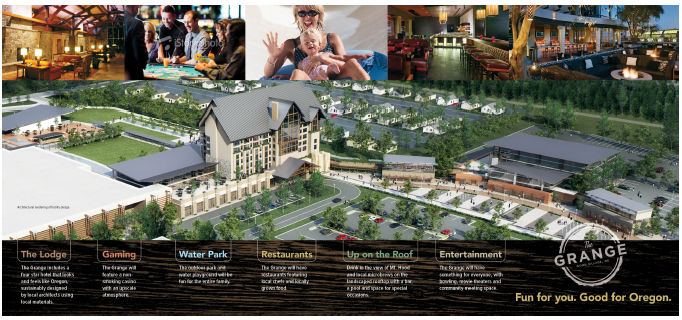 WOOD VILLAGE, Ore. – Nearly two weeks ago, as Grange members across Oregon finalized preparations to present our organization to fairgoers of the Oregon State Fair, the public learned of a new proposed casino that would be called “The Grange.”
Situated in the suburbs of Portland, less than 5 miles from the Washington-Oregon state line, the proposed casino would inhabit an abandoned dog racing track.
The casino developers, backed by a Canadian venture capital firm, launched two YouTube videos saying the new business would bring 2,000 jobs with health care to the site and give millions of dollars each year to the state, earmarked for education and other expenses. They also held a press conference announcing plans – if only state voters in November would vote “yes” on ballot measures 82 and 83, to allow non-tribal gambling in the state, specifically in Multnomah County.
Within hours of the discovery, National Grange Trademark Manager Leroy Watson had contacted legal representatives for the proposed casino group.
“We took fast action, because as in other trademark cases, the faster we learn about the potential infringement and reach out to those involved, the less damage we hope will be done to our brand as a community service, fraternal organization,” Watson said.
National Grange President Ed Luttrell said the move by the developers potentially hurts the entire organization.
“We believe that any unauthorized use of our trademark for commercial purposes diminishes the reputation of our National organization with more than about 1,500 local, county and state Grange chapters across the nation that conduct social, cultural, educational and civic programming to support rural communities and family farmers,” Luttrell said. “In the initial stages of this, we hoped that damage could be mitigated or avoided entirely, but as of now, we believe that may not be the case.”
Oregon State Grange President Susan Noah said after recent discussions with members and nonmembers, she believes the damage to our image may already be done.
“At the fair, our members met with so many people that couldn’t believe the Grange was building a casino or didn’t understand why we would be involved in such a project,” Noah said. “The advertising and the way people took it was deceptive enough for them to believe we – the real Grange – has a part or supports this casino. It’s heartbreaking.”
Oregonians were not the only ones introduced to “The Grange” as a casino. The company has sponsored ads and links that make it the first to come up in a Google search with the word “Grange” and have ads for the casino seen on websites all over the country through Google’s AdSense Program.
The National Grange, through its trademark legal counsel, issued a cease and desist letter, which asked developers to halt the use of the name “Grange” as part of the project by Aug. 31.
When the developers did not comply, a meeting between National Grange representatives, including National President Ed Luttrell and Executive Committee Chairwoman Betsy Huber, and casino representatives was held Tuesday.
As of press time, it was unclear the outcome of the meeting, however, Luttrell said the face to face meeting gave all the opportunity to clarify their position.
The National Grange also worked with the Oregon State Grange to schedule a press conference for Wednesday to reassure the public that the Grange is not involved with the casino project.
And all the while advertising for the project continues.
As part of the advertising, the casino developers have launched a full-scale campaign including large network and cable channel ad buys in Oregon, direct mailings to Oregon residents and have done interviews on radio and in print about the project.
The proposed casino’s website references a Grange as “a large hall where people gather; it’s a place for community.”
The plan, which includes a proposed waterpark, farmer’s market, bowling alley and movie theater according to their advertising, would be a destination for families, advertisements said.
“It’s not hard for someone who only has heard of the Grange to assume we have some part in this proposal when they hear of a family-friendly environment. We work hard to be a place for families and communities to come together, and these ads prey on that image of our organization,” Noah said.
Watson also said he and other members of the Trademark Protection team were working to establish a 501(c)(4) legal defense fund that would allow interested individuals to contribute to the fight against the infringement by the
proposed developers.
“With every moment we spend on this, we are spending money that we could use to continue the excellent work of our organization in communities across the country,” Watson said. “Trademark fights like this not only hurt our reputation but also hurt our members and the communities they serve.”
Further details about the pending infringement case and the proposed casino will be available at the National Grange website, along with information about donating to the legal defense fund.


