Grangers storm the Hill

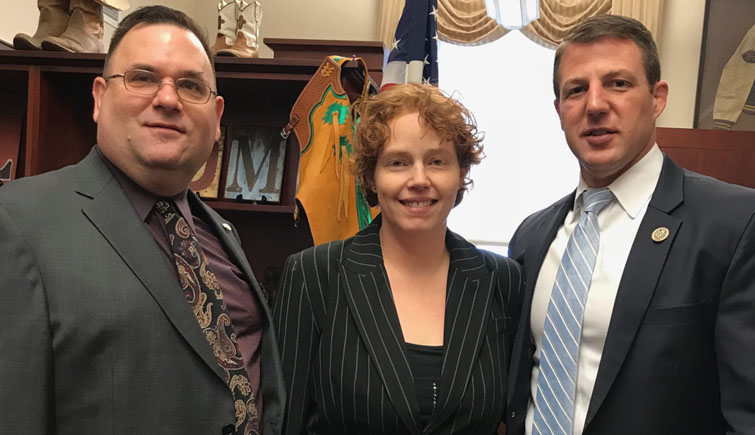 Annually, Grangers descend upon the Nation’s Capitol, determined to learn more about priority issues for the organization and taking to the Hill to discuss these issues with legislators and their staff members.
Most attendees from the fourteen states arrived Sunday, April 15, and had a meet-and-greet at the event hotel that evening.
Early Monday morning, briefings got underway at the National Grange building starting with speakers discussing rural broadband and spectrum distribution for the purpose of speeding the spread of broadband to remote communities.
“This is always a great event that reminds our members how policies grew from a grassroots process and allows legislators to hear directly from those grassroots about what’s important and what’s going on back home,” National Grange Legislative Director Burton Eller said.
Jon Conradi of the coalition Connect Americans Now provided details about the idea to use spectrum – different radio frequencies currently set aside as channels for different use like television and radio – as a method to extend broadband from infrastructure like poles to homes and areas unable to access high-speed internet through fiber connections.
Eller said CAN is one of the most recent coalitions the Grange has joined but because of our long history in the area of rural access, we are a major voice on the subject.
“The National Grange encourages the development of all forms of Broadband deployment to connect rural and small community with high speed technology,” according to Eller.
Conradi said there is very little opposition to the plan to take three channels – which don’t need to be consecutive – for broadband expansion in rural or underserved areas, noting that the move would likely not even be noticed and would not negatively impact the majority of TV or radio users anywhere in the country.
Other technology to expand broadband access, called small cell or 5G technology, was on tap next during a presentation by Susan Diegelman, Vice President of Public Affairs for AT&T, one of the event sponsors. Small cells technology is currently being tested throughout several states in especially hard-to-access areas due to mountainous terrain or distance from other access points, Diegelman said.
Next, participants heard about challenges to Lifeline, a program that allows low income individuals cellular phone service for free or a reduced cost. Mark Rubin, Senior Executive for Government Affairs for TracFone, a sponsor of the event, told the group that while often the program is painted as one used only by urban and minority individuals, the neighbors of Grangers in rural areas are nearly as likely to be part of the program’s 12 million participants with 45 percent of users coming from rural areas. That disproportionate use by rural residents would then greatly negatively effect rural individuals if a current proposal by the FCC to limit access to the program would go into place.
Last that morning was a discussion about insurance, healthcare and concerns about Medicare Part D changes by Marissa Watkins, PhRMA Senior Director for Advocacy and Strategic Alliances. PhRMA, an organization that represents prescription drug researchers and manufacturers and also served as a sponsor of the event, has been significantly concerned with several interest areas important to Grange members including changes that have taken place regarding Medicare Part D payment formulas and the opioid crisis.
During lunch, participants heard from Ray Starling, who serves as Special Assistant to the President for Agriculture, Trade, and Food Assistance at the White House. Starling discussed issues he and the President have been working on the ensure a bolstered and sustained economic growth for American agriculture. He took questions from members and provided an inside view of White House priorities.
During the session, Zaid Kurdieh, who along with his wife, Haifa, owns Norwich Meadows Farm in upstate New York talked with Starling about what he sees as problems with the current visa application process to bring in temporary workers.
Kurdieh showed the group his more than 400-page application he has to file to bring in workers for his vegetable farm. He said theirs is the only farm in the United States that applies and brings in workers on an H2-A visa program from Egypt – something he has chosen to do after having hired workers from many other countries in the past like Mexico and from Central America but who for various reasons did not work out well for their farm.
Starling said there are a lot of small changes on the horizon that will make big differences for farmers like the Kurdiehs.
Attendees were treated to briefings at USDA in the historic Williamsburg Conference Room near Secretary Perdue’s office. Blake Rollins from Secretary’s office, Shawn Arner, Rural Utilities Service, and Alton Komura, Rural Housing Service, presented an overview of the Secretary’s priorities, initiatives to expand rural broadband infrastructure by USDA, and funding partnerships available at USDA to assist rural communities.
While Junior Grange members who were in attendance then were interviewed by RFD-TV, other attendees split off to do Hill visits or spend some time touring the city before heading back to the Grange building for dinner and a discussion about challenges to farmers, led by Zaid Kurdieh. Later the discussion transitioned into topics about raising the profile of the Grange on issues, Grange growth, importance of adhering to our meeting structure and more.
“I think it was a really positive discussion that shows just how passionate our members are about our organization and their view of the importance of the Grange in today’s society,” National Grange President Betsy Huber said.
Attendees were also invited to visit the Verizon Innovation Center where they learned about connected technologies increasingly found in farm and other machinery.
The major objective of the National Grange Fly-In is to carry local, state and national Grange policy positions into meetings on the Hill with their Senators, Representatives, and staff liaisons. On Tuesday and Wednesday, 34 Grangers from 14 states had 30 meetings to discuss the farm bill, broadband, Lifeline communications, the ag workforce crisis, rural health care, the opioid epidemic, commodity prices and many more issues with their legislators from back home.


