OPINION: What Government Should, Shouldn’t Do to Advance Mobile Tech in Ag

The convergence of technology and agriculture has revolutionized modern farming. From streamlining communication, to allowing remote crop monitoring via wireless sensors, to guiding farm machinery, there are scores of examples of ways in which modern farmers and ranchers rely on mobile devices to make their operations not just more efficient, but more sustainable. As our attention shifts to confronting the array of threats stemming from the coronavirus and seek to mitigate risks, mobile connectivity has become vital for everything from connecting students and teachers, working remotely, checking in with loved ones, and longer term planning. Many of us will be focused on increased efficiencies and stretching resources in the face of serious economic hardship in the days, weeks and months ahead.
Leveraging technology will be a critical component of how we make the necessary changes to how we live, learn, and work, going forward. The good news is that for many of us in and around the agriculture industry and those of us who reside in rural America, adoption of mobile technology is nothing new.
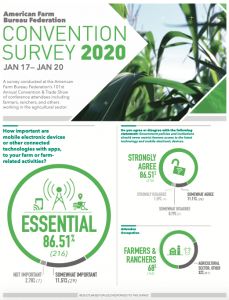 A survey conducted at the American Farm Bureau Federation’s 101st Annual Convention & Trade Show in Austin, TX of more than 250 conference attendees – including farmers, ranchers, and others working in the sector – provides a snapshot of the widespread use of mobile technology in agriculture and underscores the need for government policies that promote continued access to mobile devices.
When convention attendees were asked, “How important are mobile electronic devices or other connected technologies with apps, to your farm or farm-related activities?,” the results were stark. 86% of respondents said mobile electronic devices or other connected technologies were either “Essential” or “Very Important.” Less than 3% said mobile technology was “Not Important.”
Essential 55.95%
Very Important 29.76%
Somewhat Important 11.51%
Not Important 2.78%
But continued access to the mobile devices that farmers and ranchers need is not a foregone conclusion. Several government agencies have correctly recognized the hurdles that rural communities face in securing mobile access; the FCC, for example, has pledged billions in funding to establish 5G connectivity in rural communities, which has the potential to transform agriculture.
Unfortunately, however, another federal agency is placing rural access to modern technology at risk. The US International Trade Commission (or “ITC”)—an agency that is supposed to protect American industry against unfair foreign competition—has in recent years seen a host of petitions filed by rent-seeking entities threatening “exclusion orders” that would ban the importation of smart phones and other connected devices that are used widely in rural America.
One current ITC case that we are watching anxiously targets devices made by Amazon, Dell, HP, Microsoft, Motorola Mobility, and Samsung. The exclusion order, which is requested by an Ireland-based patent troll, would bar the importation of more than 50% of all Android smartphones and 97% of premium Android smartphones, in addition to 80% of Android tablets. That exclusion would be devastating for the nearly 40% of Farm Bureau survey respondents who said they rely on Android devices—not to mention the millions of other Americans who do as well.
On February 14, the same Irish troll filed a second ITC complaint, this time threatening even wider harm to rural access to mobile devices. Brazenly, the troll asked the ITC bar the importation of touchscreen products from Amazon, Apple, ASUS, LG, Microsoft, Motorola, Samsung, and Sony. Combined, those companies comprise over 90% of the U.S. smartphone and tablet markets. If the Commission goes along this order would present a sweeping blow that would drastically widen the digital divide and hamper the array of modern agriculture operations that rely on mobile connectivity.
Federal agencies should be encouraging, not hindering, rural access to affordable connected devices. Farm Bureau Convention attendees agreed—the respondents were nearly unanimous when asked whether they believed that “government policies and institutions should never restrict farmers’ access to the latest technology and mobile electronic devices”:
Strongly Agree 86.51%
Somewhat Agree 11.11%
Somewhat Disagree .79%
Strongly Disagree 1.59%
That’s a compelling statement about the strong bond with between today’s farmers and mobile technology. The more that farmers can harness the power of mobile technology to become more efficient, competitive, and sustainable, the better for everyone. The U.S. government must remain committed to fostering equal access in rural America. It is critical that agencies fully consider the effects of their actions on the public especially where government action could substantially hinder rural connectivity.


